
Back in 3rd Edition D&D there was a spell called “Holy Word” that could kill non-good creatures within a 40 foot radius of the caster, if the caster was sufficiently high level relative to the creatures. Good creatures were completely unaffected.
When tightly packed you can fit about 2000 people into a 40-foot-radius circle (total area is 5000 square feet). So one casting can deal with the population of a good-sized town. My gaming group speculated for a while about a society where it was a routine ritual to round up all the peasantry and nuke them with Holy Word to keep the population clear of evil. Never incorporated it into any campaigns, though. It’s a bit of a sticky philosophical puzzler.
This is a weird one because despite being a “good” spell, it entails the mass murder of innocent neutrals. It really doesn’t seem like a good action to me.
It seems like anyone who was okay with this would fall to neutral or evil simply by virtue of being okay with mass murder, and in turn fall victim to the Great Neutral Purge.
Indeed, hence the sticky philosophical puzzler. I would think that the clerics themselves would start getting affected by the spell. Fortunately (for them), the effect of the spell when cast on someone of the same level as yourself is only deafness for 1d4 rounds. The Church could probably cover that up.
There was another interesting related situation that came up in an actual campaign I was in, involving the Blasphemy spell (a variant that only kills non-evil targets). My party and I were in our “home base”, a mansion belonging to an allied NPC noblewoman, planning out our next excursion. A powerful demon we’d been tangling with attempted to scry-and-fry us, teleporting in and nuking us with Blasphemy. Unfortunately there were a lot of low-level NPC staff working in the noblewoman’s household and the spell wiped them out instantly… except for one guy, who happened to be of evil alignment. He survived the encounter because of that.
Even though his alignment was evil, though, he’d never done anything wrong and didn’t seem like he had any reason to do anything wrong in the future. So we weren’t sure if we should fire him or what. It wasn’t illegal to simply be evil, you had to actually do something evil before you could be punished. We just warned him we’d be keeping an eye on him, in the end, and kept him on staff.
I’m pretty sure if you aren’t a creature from a celestial plane of evil or good, only your actions define your alignment, not the other way around.
Okay, he hadn’t done anything wrong to us. I guess we could have paused the main campaign to spend a while investigating him, but we were doing one of those save-the-world things so we didn’t have the time. :)
I feel like there might be interesting ways to deal with it. Perhaps the mass killing of neutrals only ever happened the first time, which could have been many generations ago and under singular circumstances. Since then, only the odd one here or there ever dies during the purge. Perhaps it’s been decades or centuries since anyone died to the purge, reinforcing belief in it’s effectiveness as a basis for a pure society. It may have been so long that people wonder whether the purge is even real, or just a traditional ceremony carried out annually based on old myths. Then one year, it wipes out half the city. The party investigates?
The ritual could have been real, but was quietly faked so that a corrupt leader could avoid facing their fate.
Or, the ritual was always fake but used as a cover to assassinate specific targets without consequences.
Yes! And the ambiguity means the DM doesn’t have to decide which it is until the players have deduced certain facts.
whoever is casting that spell into a crowd of peasants will definitely turn evil
Followed by 3 quarters of the party dying to the ritual, most likely.
If they’re high enough level relative to the caster the spell doesn’t do insta-death, it just hurts a bit.
Otherwise the clerics would probably nuke themselves the first time they tried this. Maybe. The ethics of this spell are confusing.
What is being good except having self-imposed restrictions to avoid doing something evil? This spell seems perfect. There will rarely be a time where a good aligned character could justify using it in an overpowered way. If it were inverted then you would see evil characters using it all the time. It’s a self-imposed balance. You have a very powerful tool, but you must avoid using unless absolutely necessary.
Ah, but there is an evil equivalent, Blasphemy. It affects non-evil creatures instead of non-good creatures, and as such has no self-balancing properties. There are even equivalents for Law and Chaos, which are… worryingly abstract.
Hmm, yeah. That doesn’t seem like a great idea to give to people…
Only good? What about neutral alignment? (if that was a thing)
I hate these filthy Neutrals, Kif. With enemies you know where they stand but with Neutrals, who knows? It sickens me.
Here’s the SRD entry for the spell. It definitely nukes the neutrals.
The evil equivalent is Blasphemy, which nukes all non-evil creatures. Yes, the neutrals get it from both sides.
Then there’s Word of Chaos and Dictum, the Law and Chaos equivalents of those Good/Evil spells. Neutrals, believe it or not, death!
Pick a side, you neutral scum!
Good.
What makes a man turn neutral? Lust for gold? Power? Or were you just born with a heart full of neutrality?
Clinical depression
I have a sunny disposition that’s balanced out with depression. True neutral.
All I know, my gut says maybe.
Well, my parents were worshipers of Ishtar, so I was kind of born into it…
My favorite characters are TN Wizards or Clerics
Here’s the SRD entry for the spell. It definitely nukes the neutrals.
Which is kind of horrifying because most of the population of any given setting is supposed to be neutral. The average commoner isn’t so greatly committed to following airtight moral codes that they’ll ping on a detect whatever spell, whether that’s good, evil, law, or chaos. Cast that on a crowd of randoms and you’ve probably wiped out three quarters of them.
It was a bit different back in the 3rd edition days, “good” and “evil” were slung around a bit more liberally. I believe it wasn’t until the 5th edition when they introduced the “unaligned” state, which is sort of “neutral but without the commitment”, and assumed most average folk were unaligned.
Presumably before the high cleric casts Holy Word there’d be a festival ahead of time in which people are given plenty of opportunity to donate to good causes (ie, the Church) to crank up their good meters before being “tested.”
I feel like the average townsperson would sit between neutral good/lawful neutral.
Implementing a system like that would kill a lot of innocent people and the occasional guilty person.
Accidental realism
Tell my wife I said… hello
Upvoted purely for the Futurama reference.
The ‘both sides are the same’ idiots certainly deserve it
I now want a campaign based on those 4 spells, as swords.
I hate these filthy neutrals. With enemies you know where they stand, but with neutrals, who knows? It sickens me.
Another aspect of the puzzle is that not every evil deserves death. A bum who does minor theft almost as a habit, a hateful bitter man who antagonizes everyone but obeys the law, a teenager, a greedy business person who employs half the town but makes everyone’s life a bit worse, and so on.
Good should have the self restraint to not go straight to murder.
a hateful bitter man who antagonizes everyone but obeys the law
As one of those hateful bitter people in the eyes of others who still is lawful, I emphatically tell you that we are evil and absolutely would and should be killed by Holy Word and other such spells.
a teenager
Wait, what?
Actually everyone on your list should be killed by that spell, even the teenager though I vehemently disagree with that.
Like you can sit there and quibble about what is actually evil or not but this is magic, and what matters is what the majority of people consider evil, and they all hit the mark. Most adults are ageist bigots who’d wipe out all teenagers on a dime if they could, for example, even though that’s pretty evil.
Good and evil are honestly pretty meaningless.
That’s what he’s saying, the spell can’t discern between the mass murderer and the lowly thief, the user of that spell should have the restraint to not jump straight murder. Not all evil beings deserve death.
Debatable. I don’t really think the thing is about what people deserve. A sword like that could be used for all kinds of different things, not just some moral crusade.
Hell, I’d use it to detect so-called good people without the stabbing and avoid them. The worst kind of people are good ones. Goodness itself is a kind of evil.
People are quibbling over what is good and evil but no one considers how useful a sword like that would be. D&D already has a hard-coded alignment system with predictable behaviors associated with each alignment so implying good and evil are subjective is meaningless.
Then again, morality itself is pretty meaningless so 🤷
I can’t speak for the mechanics of any game you’ve played as the GM can change these things, but most people don’t treat Good and Evil as being so simple. Most games I’ve been in treat evil as varying degrees of selfishness while good is selflessness. The landlord that mercilessly squeezes the tenants for an extra nickel would probably be evil, maybe not as evil as a vampire who kills to sustain their immortality, but still evil. Just because someone is evil doesn’t mean they deserve death, we don’t execute thieves in the real world.
A magic weapon or spell that can only harm evil people doesn’t mean that you can nonchalantly use it. If you used holy word in the middle of a crowd and killed 30 people who were just shitty people you’d be evil as well. The same goes for using the sword, if you go around stabbing people to see if they are evil it would make you evil.
Not sure how you’d use the sword to detect evil people without the stabbing part, what are you gonna do, tap them with the pommel and see if they felt anything?
Did you seriously say a bum who commits a minor theft deserves the death penalty? Or should I have more coffee?
Having used to be that bum, yes, I can say emphatically what they’re doing is evil by conventional standards. I agree wholeheartedly with what they do, but that doesn’t change the fact that it’s evil and by that game’s standards they should die.
Items like that go by the standards established in the game and that means that homeless dude is gonna die. Conventional western morals dictate he be jailed, at least, and most Americans do want people like that exterminated because they dehumanize the homeless. Even restorative justice types don’t actually view or treat homeless people like humans let alone peers. Homeless populations are pretty universally reviled, and as good and evil always boil down to our feelings and popularity contests, that’s what makes them evil in the eyes of others.
I am not agreeing with the notion, just saying what it is. Personally I think humanity is inherently evil so all humans should die from such an item or a spell. But no one would take my opinion into account so this morality-is-relative crap people are pulling to dispute the veracity of the sword doesn’t hold water either.
Chaotic good Santa Claus?
I’d say “kill ‘big’ evil, stun ‘normal’ evil” would be a better spell.
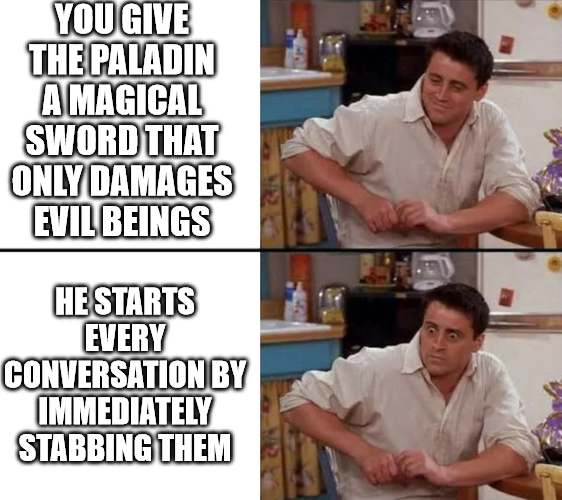
The sword’s power changes with time, and as it racks up more kills. Soon, it gains a +1 to attack and damage. Then, it can become wreathed in flame as a bonus action. Then, it grants advantage to checks made to locate creatures. Then, its base power inverts and it can only kill non-evil creatures.
Do not tell the player about that last one. Insist to the player that it works exactly as you first described. The Paladin can kill innocent shopkeepers and little old ladies, but cannot kill this assassin working for the BBEG.
Will he question his own stab-first ask-later methods? Or will he turn evil without even noticing?
I personally hate this kind of twist. If you need to actively lie to your player, not just mislead with some clever wordplay, it always feels like you’re breaking trust.
Why explain it in meta, instead of the old trustworthy totally-not-a-witch saying it only affects evil?
Still is a betrayal of trust if the player prices the sword effects are over way then it changes. Video games rarely do this because breaking that trust feels terrible.
It also defeats the point of the exercise. The paladin is nolonger responsible for the murder of those innocents because he was lied to about the true nature of the sword and would have no way to find out the truth without killing an innocent person.
So it’s not the paladin doing the killings, it’s the DM.
If I were doing this, I wouldn’t describe the effects exactly (except the +1). I would just tell them it misses every time they attack a non-evil character first, and describe it being wreathed in flames. Then for the swap just tell them who it misses or hits still, but they have to figure out both times what the effect is (or that it changed).
As if you aren’t evil by lying to the player.
And as if they won’t successfully dispute it.
It makes perfect sense. The paladin found the exploit.
Suck to be neutral lol.
To be fair, the sword kept nagging him.
“You should draw me, i bet that guy’s really evil” OKAY FINE SWORD-NIMI YOU CAN EAT THAT OLD MAN
Oh hi Nightblood. Where did Vasher go now?
Now throw him a good character with some magic immunity that negates the effect of the weapon.
I mean, that sounds very much like a paladin in unapologetic violation of one or more of their oaths.
I mean… theyre not harming anything good so not really?
But would it kill neutral innocent people?
Are neutral innocent people evil?
I could see a Vengeance Paladin justifying through divine will or whatever
It does sound like Frank Castle living out that one scene in Westworld.
Yea, blatant murder and assault isn’t justifiable to most good deities or codes of ethics, even if the target pings as evil. “Oh this shopkeeper is evil? Guess he dies.”
At the least, it’s highly illegal most places, so even if there aren’t divine consequences there’d certainly be social ones.
Yeah, even when alignment is proof enough you still need trials, and a random person’s magic sword isn’t exactly reliable proof in itself.
Can it fail? Can it be tricked? Is it a magical effect, or a divine one?
What about people who have done horrible crimes but served their sentence?
You can’t expect to wield supreme judicial power just cause you threw a sword at some watery tart.
Link: The Faces of Evil
COOL, HUH?
I wanna play that game
Have him stab the mayor who’s evil because he’s greedy and selfish and borderline abusive in trade-deals with neighboring regions but is otherwise beloved (and has rewards heaped on him) because he’s so good at actually keeping order in the town and keeping their goodwill (although probably at least a little bit through some passive-aggressive blackmail). That’s always fun.
If one were to base their diet around moral responsibility, would eating only what the blade can cut be reasonable? Can it cut vegetables? Can animals be evil? Would training a cow to be evil in order to avoid starvation be morally justifiable?
Training a creature to be evil so you can kill it is definitely evil.
Okay but if this became common enough that every paladin had a sword that only killed evil things and they also had the restriction that they had to only eat what they killed then it would be a good thing to raise evil creatures as food sources for the paladins, even though the people doing the raising are doing an evil thing.
I don’t think a cow can be good or evil.
Then they’re paying to sustain an evil industry, which is itself evil.
A paladin whose diet consists of roast demonflesh. Hm.
TONIGHT… WE DINE IN HELL! TOMORROW, THE UNDERDARK. THAT CONCLUDES OUR ANNOUNCEMENTS FOR THE DAY.
Can’t find out without fucking around 😉
Without lawyers, the kingdom was unable to resolve disputes and fell into chaos.
See, here’s my problem with that: humanity is inherently evil so everyone would be killed by such a thing.