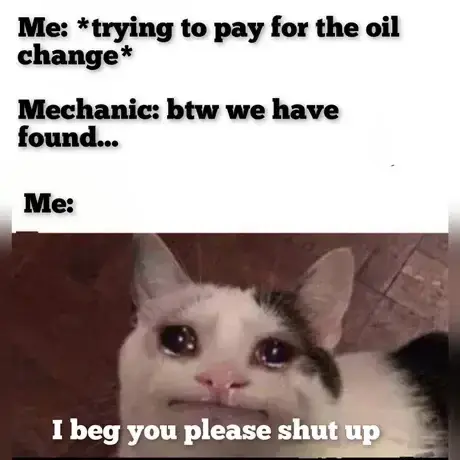

I’d recommend an electric car for avoiding oil changes, but I think we still have a few more years until cheap second hand electric cars become available.
No, a electric car is twice the price of an ICE car. It’s not an oil change per year that will break the deal.
Also don’t believe the 3000 miles oil change, it’s a scam. I change my oil every 8000 miles, there’s zero problem with that, especially if you put synthetic, but dino works the same.
This is only true if you’re purchasing used. Anyone in the market for a NEW car absolutely can and should be considering an EV.
Also, you would be fucking shocked how expensive an oil change can be on some cars, even when doing it yourself.
Depends on if you shop around for oil. I can usually get mobile one high mileage synthetic for about $5/qt at Walmart and buy filters at napa when they have a deal on buying multiple qty.
So $40ish for full synthetic high mileage oil change.
Yeah most* engines can fairly easily do 7500mi changes on good synthetic. Even my 30 year old Honda expects 7500mi changes from the factory.
*I say “most” because a lot of modern direct injected turbocharged engines (designed for efficiency) have issues with fuel washdown due to DI cold starts and high turbo bearing heat cooking the oil to death. Those actually do need 5000mi oil changes typically, especially since 0w20 and 0w16 has real low film strength to start with.
To be sure of any OCI do an oil analysis from a lab like Blackstone at the end of your extended interval to make sure it’s still in acceptable shape.
If you’re purchasing new, getting a Tesla Model 3 is usually cheaper now than other mid end ICE vehicles.
The type of person this meme if referring to clearly doesn’t have the money to buy a new car.
Also fuck Tesla and its shitty owner.
Man grab your toxiness and gtfo
No u.
You have a day old account btw.
so…?
Go back to Reddit with that BS.
Also going to count my “karma”?
It makes you a toxic hypocrite who looks like you’re either ban evading or sock puppeting on your new account as you screech at people to “go back where they came from,” dumbass.
I’d recommend not being poor
Which will also need a costly battery replacement not long after buying it 😬
I’ve had an electric car since 2011. The battery looks like it will last another 10 years.
Early Nissan Leaf batteries degraded relatively quickly (8-10 years) due to poor battery chemistry and no thermal management. Both of these issues have been fixed in all new electric cars (except the new Nissan Leaf which still doesn’t have battery cooling).
Even the old degraded batteries are valuable as static energy storage, and several people are using them as house batteries.
Most of the cost of a battery replacement is the manufacturer markup. There is at least one company making replacement Nissan Leaf batteries for significantly less than Nissan, and they include the latest chemistry and liquid cooling (unlike Nissan who just give you a second hand battery).
Most electric cars today have a 10 year warranty on the battery. Manufacturers wouldn’t be offering that if there was a reasonable chance you would need to replace the battery in that time.
Even if today’s EVs degraded like the first Leaf, when you start off with 250 miles of range you could lose a third of it and still have a very usable vehicle.
Would you mind sharing which EV you have that has a battery that will last 22 years with normal use?
I have a 2011 Nissan Leaf AZE0 24kWh with about 40% battery degradation. It can drive about 80km (50mi), which is perfectly adequate for a second car. It is rarely driven more than 20km in a day.
My other car is a 2018 Nissan Leaf ZE1 E+ G 62kWh with about 4% battery degradation.
The fastest battery degradation happens when the battery is new, and the degradation slows down gradually over time. I expect the 2011 Leaf to still have at least 50km range in 2041, and the 2018 Leaf to still have at least 200km (130mi) range in 2038. Both of these will still suit my needs.
No, it will not. Stop spewing nonsense.
My 02 VW diesel goes 10,000+mi between oil changes. 50mpg fuel economy. The car cost $6000
Answer: hydrogen
Actual answer: Public transportation and bicycles
Actual actual answer: WFH
A job is not the only place any given person would have the need to transport themselves to.
Seriously, unless you’re working a labor job in manufacturing there’s little reason to do 90% of all white collar jobs in person. It’s all staring at a damn computer screen anyway so who cares where you do it from?
Seriously… Everyone is missing all the side b.s that comes with cars especially new cars…
My car was “cheap” for a new car and it still came with a lane change radar thing… Guess who has a $1200 windshield replacement now because some schmuck kicked up a rock with their car? $300 was expensive for a windshield but now I need a freaking sensor alignment too?
Yeah
…are far too slow to be a practical substitute for a car.
In the US? Yep! We really need working public transit that isn’t seen as a poor person’s “punishment”.
Public transit only works in densely-packed cities. I do not want to live in a densely-packed city. In suburbs, where life is relatively pleasant, public transit is agonizingly slow compared to cars.
It works pretty well here in Berlin. The trains go far to the suburbs and beyond, are fast and comfortable. You pay 49 euros a month and can travel anywhere in the country with the ticket. Most of them go even at night.
Well, why don’t you compare? Open up Google Maps. Choose two points in the suburbs, and see how long it takes to travel between them by car versus by public transit.
I did the same, between my apartment complex and a nearby business, and the estimates are 12 minutes by car and 47 minutes by bus. Main problem: there’s a transfer in the middle of this route where I’d have to wait 11 minutes for the next bus to arrive.
I tried again with a different business, and got a direct bus route with no transfers and exactly the same route I’d take in a car. This is the best-case scenario for public transit, but going by car is still significantly faster: 10 minutes by car, or 17 minutes by bus.
This is highly dependent on what kind of built environment you happen to live in. In sanely built places, it’s very much not true.
You mean densely-packed cities? I would not call that sane. I would call that hellish. You have no privacy, no yard for your kids and pets to play in, almost no living space, a building manager threatening you with homelessness and catastrophic debt unless you bow to his every whim, and you pay a king’s ransom for the dubious privilege of living like that. No thank you.
A lot of untruths to unpack here.
You mean densely-packed cities? I would not call that sane. I would call that hellish.
You have no privacy,
There are forms of non-SFH density that offer plenty of privacy.
no yard for your kids and pets to play in,
The existence of rowhouses makes this false. It’s completely possible to have a yard while not living in densities that support public transportation and cycling.
Higher densities also usually come with common amenities like parks, where your children can play, and also walk to/cycle to without risking their lives. Their friends can also walk/cycle there.
almost no living space,
Baseless falsehood.
a building manager threatening you with homelessness
Higher densities does not equal living in a rental apartment, false again
and catastrophic debt unless you bow to his every whim,
As opposed to living in a house which you don’t have to incur any debt whatsoever to obtain? Hell of a statement.
and you pay a king’s ransom for the dubious privilege of living like that.
Cities are usually more expensive on account of the fact that people actually want to live there, because people want to be close to the things that they want to do, and not have to spend their lives sitting in traffic behind the wheel all their lives. Lots of places have also tax incentivized living in suburban densities to the detriment of those living in higher densities, so it’s not like the higher cost is a law of nature.
No thank you.
Generally poor take.
Hydrogen is only 30% efficient compared to 90-95% for batteries. Most hydrogen is currently made from fossil fuels, and contains less energy than the fossil fuels used to make it.
I’d love to see the technology develop more but it’s definitely not viable today. It’s like when EVs started out.
but an electric car is heavier than a hydrogen car, so the electric platform is less efficient. imagine carrying an extra ton of a batterypack wherever u go. hydrogen could be made from renewable energy, and doesn’t require batteries to be stored. battery metals are finite. u can’t scale that up. 5kg of H2 translates to 400km mileage.
Most large combustion SUVs are heavier than most electric cars.
Sodium ion batteries are being produced with no rare metals in them, and will be in production cars within a year. Hydrogen is difficult to store due to is low volumetric density, it’s molecular size, and corrosive nature.
Hydrogen (fuel cell) cars all have a battery because a hydrogen fuel cell is slow to change it’s energy output, so can’t change its output fast enough to directly power the car.
Battery electric cars are about 90% efficient from charging from the grid to moving. Hydrogen cars are about 30% efficient from grid to moving when made from renewable energy. These efficiency numbers include the weight and rolling resistance of the car. The theoretical maximum efficiency of hydrogen storage allowed by the limits of physics is about 50%.
The volumetric density of hydrogen is so low that you would need 20 tanker trucks to transport the same amount of energy that 1 tanker truck of gasoline can carry. This is at maximum pressure or liquified.
Hydrogen only makes sense when the weight of the energy storage medium is critical. As demonstrated by American cars, it isn’t.
Twice as expensive to fill as a gas car and more expensive than a battery EV to buy, all while still producing tons of CO2 by steam reforming methane to make the hydrogen? Wow, sign me up!
Hydrogen is the answer, but the question is “How can fossil fuel companies keep making money while pretending to be green?”
The technology is extremely underdeveloped. That’s why it’s so expensive and impractical right now. Batteries aren’t ecological saints either.
Hydrogen is a pain to store and work with. Even on rocket engine that is worth millions it’s almost impossible to avoid leaks.
On the other hand gas can be carried in a plastic bottle and electricity is already available everywhere.
I don’t see any future where hydrogen car become mainstream.