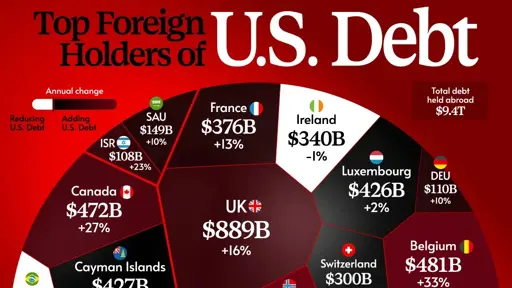
That completely misses the destructive power of inflation and currency devaluation. The interest payments are nominally coming back to Canada, but their real value is what actually matters. If the US dollar is losing purchasing power faster than the bond’s interest rate, then Canada is experiencing a negative real return. We are getting paid back in dollars that buy less which is the opposite of getting stronger. What we’re seeing here is a classic transfer of wealth from the creditor to the debtor with Canada subsidizing US fiscal policy by accepting a steady erosion of its investment’s true worth.
Your focus on the current bond overlooks the market’s forward looking nature. Yields are stable because they reflect a consensus that the Fed will eventually cut rates to avoid a recession which is a precarious assumption. The moment inflation proves stickier than expected or the US debt trajectory worsens, we could see a violent repricing happening. It would lead to a bond vigilante reaction where yields spike suddenly and crater the value of existing holdings.
The whole idea that interest payments cushion import costs only works if the Canadian dollar doesn’t weaken alongside or faster than the USD in a crisis, and that is not at all guaranteed. When a crisis hits, all assets correlated with the US including our bond portfolio would suffer together. Meanwhile, the only sector of the US economy that’s doing well are the tech stocks, and that’s just a handful of companies passing IOU notes around in a circle. The rest of the economy is showing deep imbalances with weak consumer savings, shrinking industrial output, and persistent inflation in services.
The US is funding massive deficits in a high interest rate environment, and that can’t go on forever. The war on Iran could act as a catalyst for the whole house of cards to come crashing down because it’s driving the price of energy through the roof. The resulting economic crash in the US could be far worse than 2008, and at that point we’d be left holding the bag.
We as in the working class in Canada. That’s who always pays the bill when there’s an economic crash.
I generally agree with what you’re saying regarding the US and China. However, I’d note that the actual split is between G7 and BRICS, and BRICS have already surpassed G7 in terms of PPP measure. BRICS represents the Global South, and it happens to be where majority of human population is, where the resources are, and where most of the industry is. Majority of Global South economies economies are aligned with China now.
What Carney appears to be focusing on are former vassal states that were under the tutelage of the US. Now that the hegemon is fading, the vassals are in trouble. What Carney seems to be trying to do is to rally Europe and Australia to form a bloc without the US, but one that’s not directly aligned with the Global South.
And of course GDP alone is not useful measure of anything. The quality of development matters. Western economies are focused on stuff like software industry and service economy. They’re not producing things people actually need to live. China is where all the manufacturing happens. They’re the ones who build solar panels, EVs, and high speed rail that developing world needs. That’s what makes China such a key economy for the world.
I also expect that the US is headed for collapse, and it’s likely going to be far worse than what happened to USSR. That said, it’s not at all clear that countries that hold US debt will be able to claw anything back once that happens. For one, the US is still full of nukes, so whatever states emerge out of it eventually will be nuclear powers.
The problem for Canada is more immediate though. Our economy is heavily dependent on the US right now. And unless we diversify and become more self sufficient, then we will be dragged down along with the US. Unless Canada takes steps to insulate itself then it will become one of these failed states itself when the western order finally collapses.
Yeah, that’s just completely false. The whole point of BRICS, and what actually makes it effective unlike G7, is that it’s not an ideological alliance. It’s a framework for countries to do trade. And trade within BRICS has been exploding.
Meanwhile, the EU is very clearly dying at this point. Energy prices were already sending European industry into a terminal decline, and Iran war has put the whole thing into an overdrive. Not to mention the fertilizer crisis during the planting season which could easily result in food shortages by fall. GDP is a completely meaningless metric because the quality of development is what matters. European countries do not produce things their people need to live. And what’s actually happening in Europe right now is that nationalist parties like AfD, RN, and Reform are dominating their politics. All these parties are extremely nationalist, and they are openly hostile to the whole idea of EU. The liberal center in Europe is collapsing along with the standard of living.


Removed by mod
That completely misses the destructive power of inflation and currency devaluation. The interest payments are nominally coming back to Canada, but their real value is what actually matters. If the US dollar is losing purchasing power faster than the bond’s interest rate, then Canada is experiencing a negative real return. We are getting paid back in dollars that buy less which is the opposite of getting stronger. What we’re seeing here is a classic transfer of wealth from the creditor to the debtor with Canada subsidizing US fiscal policy by accepting a steady erosion of its investment’s true worth.
Removed by mod
Your focus on the current bond overlooks the market’s forward looking nature. Yields are stable because they reflect a consensus that the Fed will eventually cut rates to avoid a recession which is a precarious assumption. The moment inflation proves stickier than expected or the US debt trajectory worsens, we could see a violent repricing happening. It would lead to a bond vigilante reaction where yields spike suddenly and crater the value of existing holdings.
The whole idea that interest payments cushion import costs only works if the Canadian dollar doesn’t weaken alongside or faster than the USD in a crisis, and that is not at all guaranteed. When a crisis hits, all assets correlated with the US including our bond portfolio would suffer together. Meanwhile, the only sector of the US economy that’s doing well are the tech stocks, and that’s just a handful of companies passing IOU notes around in a circle. The rest of the economy is showing deep imbalances with weak consumer savings, shrinking industrial output, and persistent inflation in services.
The US is funding massive deficits in a high interest rate environment, and that can’t go on forever. The war on Iran could act as a catalyst for the whole house of cards to come crashing down because it’s driving the price of energy through the roof. The resulting economic crash in the US could be far worse than 2008, and at that point we’d be left holding the bag.
Removed by mod
We as in the working class in Canada. That’s who always pays the bill when there’s an economic crash.
I generally agree with what you’re saying regarding the US and China. However, I’d note that the actual split is between G7 and BRICS, and BRICS have already surpassed G7 in terms of PPP measure. BRICS represents the Global South, and it happens to be where majority of human population is, where the resources are, and where most of the industry is. Majority of Global South economies economies are aligned with China now.
What Carney appears to be focusing on are former vassal states that were under the tutelage of the US. Now that the hegemon is fading, the vassals are in trouble. What Carney seems to be trying to do is to rally Europe and Australia to form a bloc without the US, but one that’s not directly aligned with the Global South.
And of course GDP alone is not useful measure of anything. The quality of development matters. Western economies are focused on stuff like software industry and service economy. They’re not producing things people actually need to live. China is where all the manufacturing happens. They’re the ones who build solar panels, EVs, and high speed rail that developing world needs. That’s what makes China such a key economy for the world.
I also expect that the US is headed for collapse, and it’s likely going to be far worse than what happened to USSR. That said, it’s not at all clear that countries that hold US debt will be able to claw anything back once that happens. For one, the US is still full of nukes, so whatever states emerge out of it eventually will be nuclear powers.
The problem for Canada is more immediate though. Our economy is heavily dependent on the US right now. And unless we diversify and become more self sufficient, then we will be dragged down along with the US. Unless Canada takes steps to insulate itself then it will become one of these failed states itself when the western order finally collapses.
Removed by mod
Yeah, that’s just completely false. The whole point of BRICS, and what actually makes it effective unlike G7, is that it’s not an ideological alliance. It’s a framework for countries to do trade. And trade within BRICS has been exploding.
Meanwhile, the EU is very clearly dying at this point. Energy prices were already sending European industry into a terminal decline, and Iran war has put the whole thing into an overdrive. Not to mention the fertilizer crisis during the planting season which could easily result in food shortages by fall. GDP is a completely meaningless metric because the quality of development is what matters. European countries do not produce things their people need to live. And what’s actually happening in Europe right now is that nationalist parties like AfD, RN, and Reform are dominating their politics. All these parties are extremely nationalist, and they are openly hostile to the whole idea of EU. The liberal center in Europe is collapsing along with the standard of living.
Removed by mod