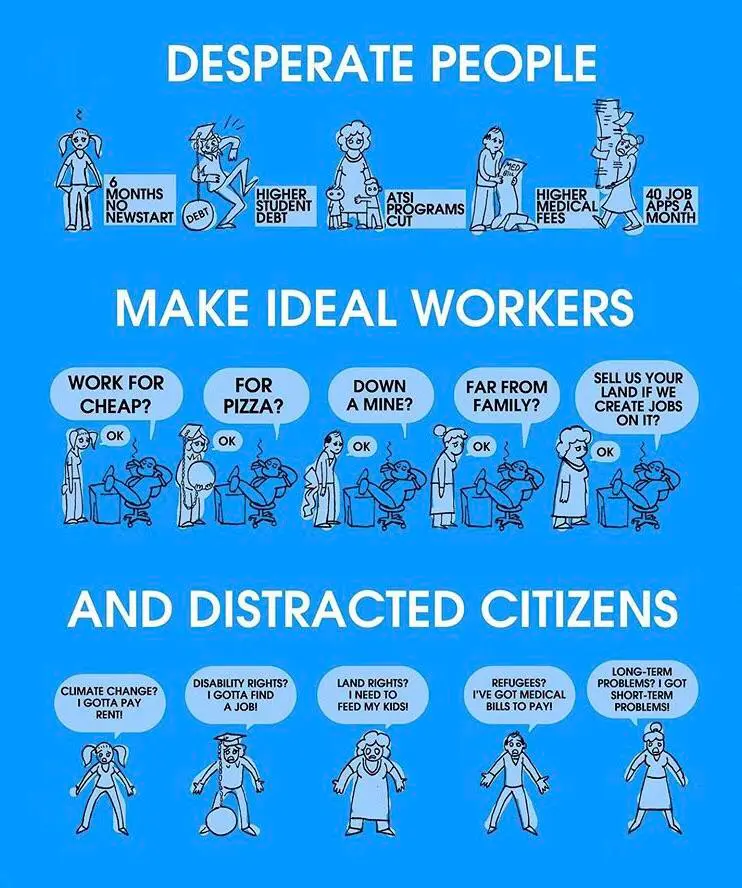
When I say I’m tired of working for a living I don’t mean that I don’t want to work, I meant that I don’t want to work for other people doing something I don’t care about so someone I don’t care about can better achieve something I don’t care about just so they pay me money for it. I’m happy to work when that goes directly goes toward my own well-being and that of my family and local community. I just get so tired of doing work that I have no personal investment in beyond “it makes me money so I can then give that money to other people.”
So I play Rimworld and dream of what it would be like to have a role in a small community where everyone does their part for the direct benefit of the community and it isn’t all just about money.
It made sense when working meant providing for families, and even in the industrial revolution where it meant making mass goods for large amounts of people to enjoy.
But what happens when we get the ability to produce more than we need with only a relatively small amount of humans to do it? If we have the resources where we can easily give everyone on the planet a cell phone, why not do it?
We are already there with some goods: for example, we currently produce enough food to feed 1.5x the world’s population. We may very well reach a point in the next 20-30 years where we can produce everything market wants with 50% or perhaps even 25% of adult humans actually working. Our solution so far is creating artificial scarcity, but that’s only going to patch the system for so long.
Already we’re eschewing traditional factory jobs for service industry jobs like meal delivery. But we’re not far off from autonomous delivery vehicles automating that away, too. With the rise of AI, we can expect a lot more jobs to be augmented or superseded by automation over time.
Capitalism rests on the premises that we can always produce more and that people’s value is tied to their labor. But in a post-scarcity, heavily automated world, these premises break down, and suddenly this system doesn’t really work anymore.
Short of a communist revolution, I think we are going to need to start trialing measures that divorce benefits from labor. Most of the world already has healthcare coverage separated from labor (USA is the glaring exception,) and the next step would likely be universal basic income.
Not sure which came first though - capitalism or human nature. Capitalism creates artificial scarcity but it also capitalizes on human nature, namely those who want to be ‘better’ than others.
In some places, people keep telling their kids ‘go to college so you’ll have a good life and be educated, not like those laborers’. As a consequence, today there might be less skilled electricians, plumbers and the like. And those jobs pay better, and are arguably less boring than, say, working in a bank with a college diploma. Point being, just like a college diploma is a sign of status, so is the iphone and some random brand-name knick-knack or eating caviar.
For society to advance to the stage you’re proposing, we first have to get over our inflated egos and our need to be better than the rest, in whatever random field we manage to, be it food, clothes, tech, cars or diplomas. I’d want a world in which the garbage man has it as good as the university professor. Not sure the university professor would, though? But they both provide valuable services to society at large.
Honestly, there aren’t that many changes we’d need to get there. For example, instead of working one person 60 hours we can work two people 30 hours. If we divorce benefits from full time status, companies won’t have to pay all that much to make the system work.
With universal income, people could opt to work part of the year, or work for a few years and take time off, or however else they want to do it. There would still be an incentive to work, just not to work to death.
It is unfortunate that this anti-work rhetoric often comes off as outrageous, when in reality it isn’t. I don’t know if the people doing it are intentionally trying to be controversial, or if they just are not good at communicating.
When we complain about work, this doesn’t mean that we are asking for a world where we lounge all day at home, and expect that food, shelter and entertainment are magically delivered to us without any regard to how it happens. No, anti-work is not about a blind sense of entitlement. But that is how a lot of these posts come off as, even if their authors don’t intend it.
Anti-work is a recognition that the working class works way too damn much; so much more than we need to to have a functioning society with everyone living happily and having their needs met. There’s so much inefficiency in capitalism, with aims to drive more capital to the wealthy, and working around other stupidities of capitalism (check out the book “Bullshit jobs” for examples). The ruling class holds hostage the world’s resources, and requires you to give them a large portion of your life to get even the minimum needed to sustain your living. Now that is outrageous.
I think a lot of people have trouble understanding the difference between “I don’t want to contribute anything to society” and “I don’t want to spend half my waking life laboring for peanuts so that my boss can get rich”.
Obviously, we should contribute according to our means, but we need to be compensated for those contributions accordingly.
…but we need to be compensated for those contributions accordingly.
This is the part they object to, thanks to the proliferation of Econ 101 thinking. Market wages are, after all, competitive by definition. For someone that hasn’t gone beyond basic economics, what you’re paid for the work you do is fair compensation.
The anti-work rhetoric is, first of all, incredibly misleading for people who take things at face value. But more important, the underlying theory for why market wages aren’t fair is different for each person you talk to. There is no coherent, rhetorically forceful reasoning for why people should be paid more. And separate messages that arrive at the same conclusion aren’t really effective at scale.
Getting paid better would be nice, but that will just bring the middle class closer to poverty. I’ve been a part of this community for a few years now and I have been fighting for better wages this whole time. But the biggest pain to me is inflation. Things keep costing more and more, but I keep making the same amount of money. Wouldn’t price regulations be a better solution to all of this to all of this? Not trying to start a fight, but looking for a slight skew from the topic.
Wouldn’t price regulations be a better solution to all of this
What would that solve though?
I mean say, a loaf of bread is price regulated at $3/loaf. Do we treat it like the minimum wage and let it sit there for 15 years at $3? What about bread producers? After a few years, they’re certainly not getting paid the market price for their production. Is that justified to ensure that bread remains at $3?
The problems of price controls are demonstrated quite convincingly with rent controls versus just building affordable housing: the former doesn’t increase the housing supply which means, even if rent is affordable, some people remain homeless.
Idk, how are thinking about it?
deleted by creator
I mean there’s a lot of wilderness and open space in the US. No one is stopping you from going out there and starting from scratch. Go ahead and do it
Yeah no, that’s actually literally illegal. You might be able to get away with stealth camping, but you can’t just set up a homestead in a fucking forest or something. That shit would be knocked down, you’d be fined, and then you’d be jailed when you fail to pay the fine.
Yes they are, moron.
Taxes are hardly optional, and they WILL punish you for seeking independence.
Yeah, if that’s an option then I respect people who do that, but if you want the comforts of modern society then you need to contribute.
Imo anti work is about pushing back on the ridiculous expectations of companies, and ensuring that employees receive some of the benefits of automation to ease the load on them.
This tweet strikes me as the “but I want everything for freeee!!!” person who makes anti work look bad. Like that idiot Reddit mod who went on Fox News or whatever news station it was.
The original anti work community on Reddit was more about the abolition of work, before being co-opted by work reformists. It wasn’t about just “pushing back”, but about abolishing the modern concept of wage labor under capitalism.
Money doesn’t need to exist, so your complaint about them just wanting things for free is ludicrous and strikes me as capitalist apologia.
I recommend reading The Abolition of Work to better understand the concept. At the very least, it would allow you to form actually compelling arguments against the idea so that you don’t have to continue showing your ignorance.
How I see this problem is that we aren’t given to tools to help us decide how we want to live our lives. Work sucks and is a waste of time. Contributing to society is valuable and something I want to do.
During the 2020 epidemic and lockdown bunches of people were furloughed and we all got to acquaint ourselves with extended cabin fever. Many of us picked up new hobbies and some of those could ne monetized and were better than the (often toxic, underpaid) dayjobs.
It was a conspicuous phenomenon now called the great resignation. Our capitalst masters compain how no one wants to work, but it’s evident to the rest of us that it’s the toxic underpaid conditions we don’t like, and we’d be glad to work if conditions were better.
I suspect laziness isn’t a real character flaw or deadly sin so much as the desire to not suffer as we work. (There is avolition, a symptom of mental illnes such as major depression, and this is what drives people to couch-potaro for weeks or months at a time.)
I think that modern work is something done to us, as a form of violence. We’re told to go here, do this, and in return we get just enough to get by. Humans are definitely not lazy, but we do have a problem with slavery.
Why the FUCK do you think you’re entitled to get the free labor of bakeries working hard to make bread, farmers farming to create food, and people building technology to make your life easier?
No, you don’t have to work. Go live in the forest and farm your own food. Maybe then when a lion attacks you you’ll realize the value of modern civilization.
That’s true, but the whole point of technology and modern civilization was to make us lazy and somehow people are working even more? Except for like 5 people.
Most people in the west can work less, if they are willing to sacrifice comfort, material goods etc.
Human nature, regardless of political systems, dictates that one and their family must provide trade-worthy value to receive trade-worthy value. There are plenty of exceptions to that thanks to charity (at any scale) and social policies that allow for some to provide little trade-worthy value and still receive essential benefits (for example, those with disabilities). But if there were an option to provide no trade-worthy value and receive completely satisfying goods, accommodations, and freedoms in return, then productive people would naturally feel foolish for spending time working any more than they like to. There is some point where there wouldn’t be enough people to maintain the benefits for the non-workers. Although people would offer to work as good will, labor and supply shortages would be far more frequent or constant. So should we allow the option, but only a limited amount so that the threshold of value-produced to value-consumed is never met? It’s unlikely that there would be good relations between the class of people in society that would be gifted with that option and those that aren’t.
Does “human nature” “dictate” that nuclear families are a central organizational structure within society, or are there plenty of exceptions, in the sense of societies following systems and cultures very different from the one under which you live?