I mean, the issue is that you’re starting with the premise that some people need to be banned. And here’s the thing - the biggest turn off to potential good members to your organization is negativity. Starting with “no bigots allowed” tells your prospective members that bigots commonly want to join your organization. The only people you will attract will be people who believe they need official organizational policies to protect themselves from bigots - ie, people who are huge, pessimistic downers all the time. It will fill your organization with people who are constantly looking for ways that others are insulting, demeaning, or dismissing them - which results in an organization that is highly judgemental, high strung, and unwelcoming.
Instead, successful organizations don’t start with (much less advertise) “no bigots allowed”. They also almost never start with “all are welcome here”, since this implies the negative thought that anyone might not be welcome. Instead, they lead with the point of their organization. The Springfield Pickup Ultimate Frisbee Club doesn’t start their pitch with “No bigots allowed”. They start with “we play pickup ultimate frisbee in the park on Tuesdays at 6pm, it’s lots of fun!” Maybe with the addendum “all skill levels welcome!”
Of course, this doesn’t mean that bigots are welcome at the Springfield Pickup Ultimate Frisbee Club. It just means that when someone shows up and starts calling people the n word, they are politely but firmly asked to leave and not return, and then everyone else goes back to playing frisbee, and then talks about what a shithead that guy was and forgets about it.
That’s how successful, welcoming organizations function - everyone is welcome to show up, and everyone is assumed to be a nice person. But they have standards, and they remove people who don’t meet those standards.

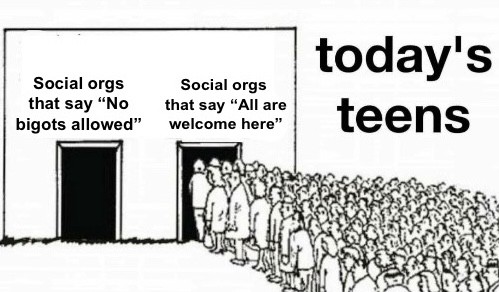
I mean, the issue is that you’re starting with the premise that some people need to be banned. And here’s the thing - the biggest turn off to potential good members to your organization is negativity. Starting with “no bigots allowed” tells your prospective members that bigots commonly want to join your organization. The only people you will attract will be people who believe they need official organizational policies to protect themselves from bigots - ie, people who are huge, pessimistic downers all the time. It will fill your organization with people who are constantly looking for ways that others are insulting, demeaning, or dismissing them - which results in an organization that is highly judgemental, high strung, and unwelcoming.
Instead, successful organizations don’t start with (much less advertise) “no bigots allowed”. They also almost never start with “all are welcome here”, since this implies the negative thought that anyone might not be welcome. Instead, they lead with the point of their organization. The Springfield Pickup Ultimate Frisbee Club doesn’t start their pitch with “No bigots allowed”. They start with “we play pickup ultimate frisbee in the park on Tuesdays at 6pm, it’s lots of fun!” Maybe with the addendum “all skill levels welcome!”
Of course, this doesn’t mean that bigots are welcome at the Springfield Pickup Ultimate Frisbee Club. It just means that when someone shows up and starts calling people the n word, they are politely but firmly asked to leave and not return, and then everyone else goes back to playing frisbee, and then talks about what a shithead that guy was and forgets about it.
That’s how successful, welcoming organizations function - everyone is welcome to show up, and everyone is assumed to be a nice person. But they have standards, and they remove people who don’t meet those standards.
Whats wrong with calling people nice?
lol. Took me a second
Something something Wendy’s
I dream of a world where everyone expects to hear a stump speach when they go to Wendy’s!
Hear, hear!
“These kinds of people are going to hell”